
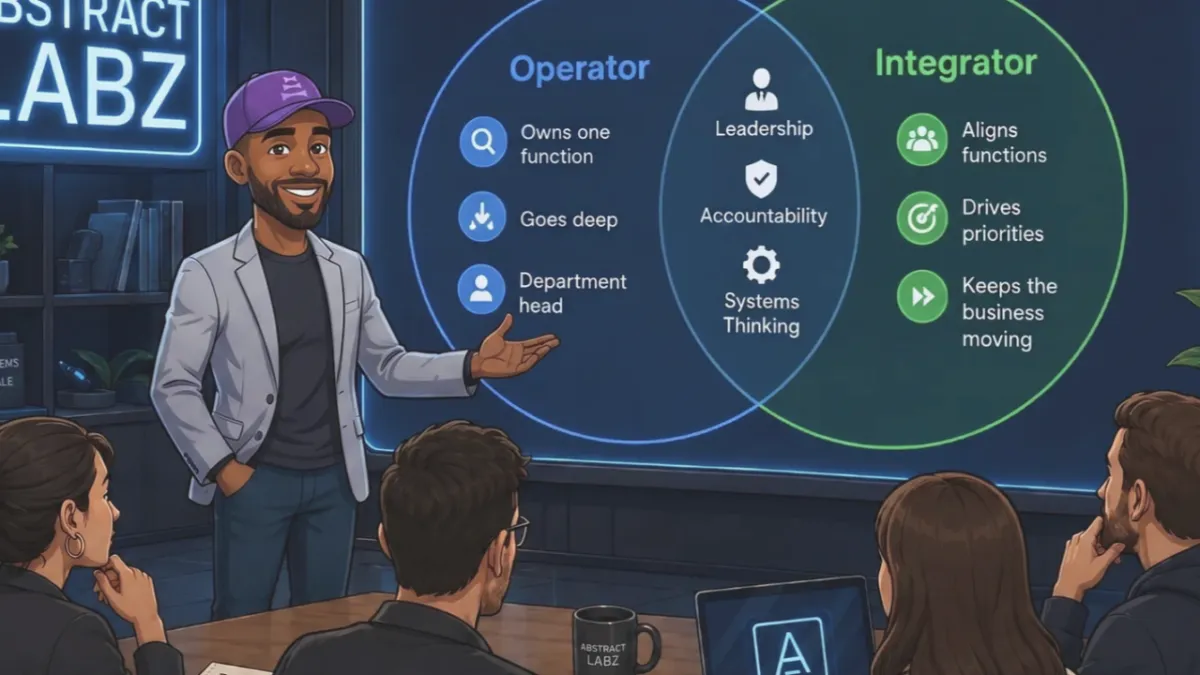
Operator vs Integrator
There is a difference and you likely need both an Integrator and Operator
A founder told me recently he finally hired an operator. He had been drowning for two years. The hire was sharp, came highly recommended.
Six months later, he was still drowning. The hire was thriving in their function. That part of the business ran smoother. But the business as a whole was not getting easier for him. He was just as stuck, with a more expensive payroll.
The hire was not the problem. The hire was excellent. The problem was the founder used the word Operator when he actually needed an Integrator, and almost nobody ever explains that those are two different jobs. Most founders never get the language, so they hire by feel and hope it works out.
The Operator
An Operator owns a function. One area of the business, end to end. If you have Sales, Operations, Customer Success, and Finance, an Operator owns one of those four. They go deep. They protect the standard inside their function and run their piece of the business like it is their own.
An Operator answers questions like how is this function performing, what are we tracking, where are we falling short, and what does this function need to be excellent. A great Operator goes a mile deep on one mile of road, making their function predictable, repeatable, and measurable.
In a small business, Operators show up as department heads. Heads of Sales. Heads of Operations. General Managers. The people you trust to own one thing and own it well.
You can have a brilliant business with a few brilliant Operators, until they start tripping over each other because nobody is managing the seams between them. That seam work belongs to the Integrator.
The Integrator
An Integrator owns the way every function works together. Not one area. The whole system. The Integrator translates the founder's vision into priorities every Operator aligns around. They run the rhythm that keeps everyone on the same page and catch what falls between the cracks because nobody owned it.
An Integrator answers questions like are all the functions pulling in the same direction, what is the operating system this business runs on, and where are the seams breaking. A great Integrator goes a mile wide and just deep enough to keep the whole business moving together.
In a small business, the Integrator usually does not have a department. Sometimes they are called Chief of Staff. Sometimes Operations Director. Sometimes the founder just calls them my right hand because nothing else fits.
I Am The Case Study
I serve as the Integrator for a property management company. Not on payroll, not the CEO. I am the person who sits across all the functions and makes sure the operating system holds.
That team has three department heads. One owns the operations of the buildings. One owns the leasing function. One owns customer success. Each of them is a true Operator, each running their function better than I could because they live in it every day. None of us could do the job of the others.
The department heads keep their functions sharp. I make sure those functions are pointed at the same goals, holding the same standards, and aligned to what the CEO is building.
Remove the Operators and nobody runs the day to day. Remove the Integrator and you have three excellent silos that do not talk to each other. That is what the architecture looks like when it works.
Why You Need Both
You do not graduate from Operators to Integrators. You build both because they do different work. Operators give you depth, how you scale a function without losing quality. Integrators give you width, how you scale a whole business without losing coherence.
All Operators and no Integrator becomes a set of well run rooms with no hallways. An Integrator with no Operators becomes one smart person trying to do every function themselves, which is exactly the problem you started with.
The Founder's Question
Before your next hire, ask yourself. Is the gap I am hiring for depth or width?
If one area of the business is not being run well, hire an Operator. Pick the function, find the owner, get out of their way.
If nothing in your business talks to anything else, decisions die in your inbox, and priorities shift weekly because nobody is holding the line, you need an Integrator. They cost more and they are harder to find. They are also the hire that changes the trajectory.
The mistake is hiring an Operator when you need an Integrator, or the reverse. The work the wrong hire does is fine. The work the right hire would have done never gets done at all.
Get clear first. The architecture follows.
Want the full breakdown? I posted it on Substack.