
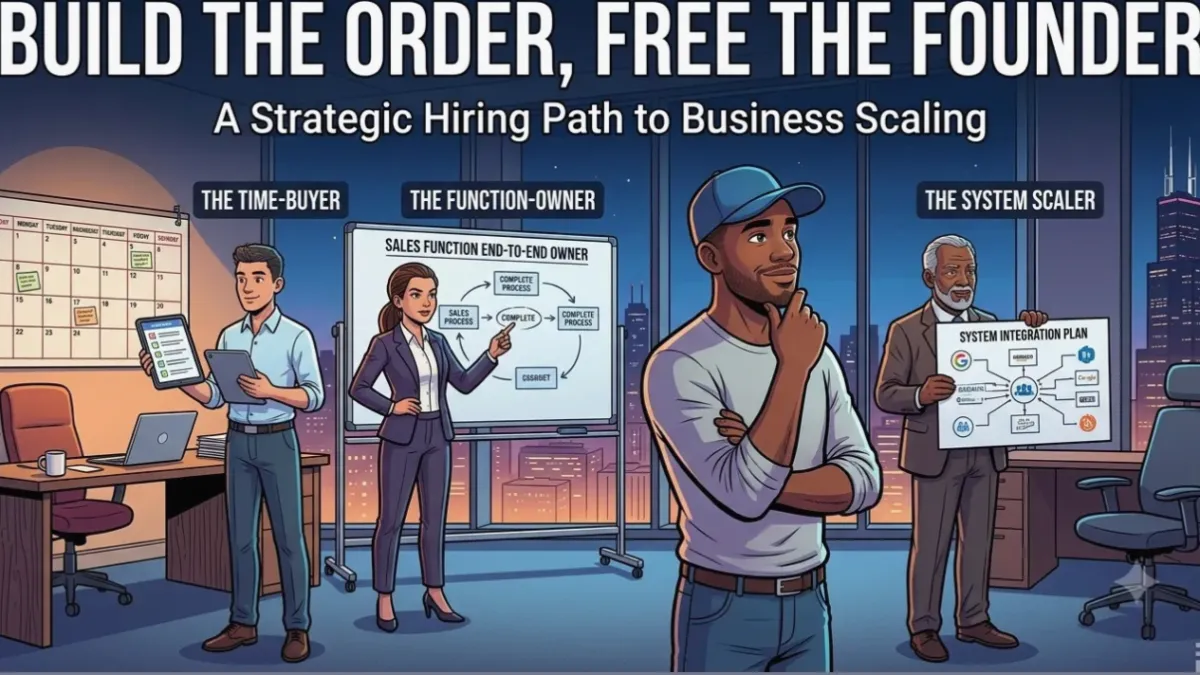
The Three Hires That Change Everything
Have you ever made a hire you knew was right, then six months later wondered why nothing actually feels different?
Most founders treat hiring like a math problem. Too much work, hire someone, work gets done, repeat until the calendar feels survivable. That works if your goal is survival. It does not work if your goal is a business that outgrows you.
Hiring is highly strategic and requires real clarity on where you are and what your goals are, because not every hire changes the same thing. There are three core hires every founder makes as a business scales. Get them in the wrong order and you hire the right person at the wrong time. Get them right and the business stops needing you at the center.
The Time Buyer
This is usually the first hire. The virtual assistant, the admin, the bookkeeper. The person who takes calendar wrangling, inbox triage, receipts, and scheduling off your plate, the small repeated things that drown a one person business.
People often underestimate this hire. It is the hire that gives you back the hours to do the work only you can do.
What this hire changes is your calendar and your bandwidth. What it does not change is your business.
Most founders confuse a Time Buyer with an Operator and ask them to own things they were never set up to own. Then the founder gets frustrated when the work does not land at the level they wanted. The hire was fine. The seat was wrong.
The Function Owner
This is the Operator. The person who comes in and owns one function end to end. Sales, marketing, operations, client delivery, whatever the heaviest function is right now.
They are not just a doer, they are an owner. You do not assign them tasks, you assign them outcomes. They build the system, recruit and lead the people inside the function, and report on its performance.
Most founders get the title wrong but the work right here. Tell them clearly, this function is yours, I trust you with it, and mean it.
What this hire changes is your business. You stop being the bottleneck for one whole part of the company, and the function gets better than it ever was when you were running it, because someone is paying attention to it full time.
What it does not change is you. You still make every cross functional decision. Your calendar is lighter, but your influence is still required everywhere.
The System Scaler
This is the Integrator, and it is the one many founders never make, or make far too early.
Some hire an Integrator before there are any Operators and ask them to own functions the founder has never released. That hire fails, not because the Integrator was bad, but because there was nothing to integrate yet.
Others wait until burnout is at the door, hire fast, and the Integrator walks into chaos that should have been organized by Operator level hires years earlier.
The Integrator works when there are Operators to integrate with. They sit across the business and own the way every function works together, the strategy, the cadence, the reporting, the hiring plan, the cross functional decisions that used to land on your desk.
What this hire changes is you. For the first time, the business runs without your name attached to every meeting.
The Order Matters
Skip the Time Buyer and you have no margin to even interview the next hire. Skip the Function Owners and the System Scaler has no functions to integrate, so their unique ability gets wasted on mundane tasks. Skip the Integrator entirely and you stay the center of the operating system forever, no matter how many other people you hire.
Each hire unlocks the next. You cannot leapfrog the order.
The Test
If your calendar is full of small repetitive work, you need a Time Buyer. Full of decisions inside one function, you need a Function Owner. Full of decisions that cross every function, you need a System Scaler.
Most founders are running one or two hires behind where they think they should be. The work that feels normal to you right now is probably the work your next hire was supposed to take off your plate months ago.
One Last Thing
People say great founders are good at bringing uniquely talented people together around a shared mission. They are right, that is the job. But what gets left out of that sentence is the order.
You can find the right people, articulate the mission, bring the energy to every conversation, and if you bring them in out of order, the whole thing still wobbles.
The right person at the wrong time will frustrate you. The right person in the right order will free you.
Build the order. Then bring the team together around the mission.
Want the full breakdown? I posted it on Substack.